Last week I published my fourth quarantorial in which I shared my thoughts and a recap of #ServiceNow #Knowledge2020, as well as some thoughts on the evolving human and enterprise condition.
Before I get into opining on various topics, let me say that I do believe what Bill McDermott said in the context of ServiceNow in his keynote, but I believe it on a much broader basis.
Bill McDermott, CEO of ServiceNow said, “The workflow revolution has only just begun, and ServiceNow will be the catalyst to redefine the enterprise, not as it is today. But as it must be tomorrow. There’s no way we can live with the cycle times of innovation that are going on with systems that are too slow, too antiquated to achieve what we all want. We all want great experiences for our teammates and for our customers. And we have to remember that behind every one of those great experiences is a great workflow.”
I might go as far as to say, the revolution has only just begun, and humans (people) will be the catalyst for redefining the world the way we have since the dawn of time, we will experiment and find a new tomorrow that we will live with until new variables and catalysts present themselves and we begin to experiment again. As time moves forward, new innovations will deliver more data, greater transparency, a lower the barrier to entry, etc. and as a species we will increase our velocity and frequency of experimentation, looking to innovate and disrupt to build a better tomorrow, the outcome won’t always match the intent, but hopefully, we can avoid extinction, only time will tell. Generally speaking, I do believe that as a species we all want a great life for all those who inhabit this planet with us, but we have to remember that in science a control set is used as a consistent test sample for experimentation. Scientifically the circumstances under which we conduct experiments and by which we will measure the outcome of our experiments matters. In science the control set is a constant used by everyone conducting experiments to measure their results, in the experiment of life, there is no control set which means that the same experiment performed in seemingly the same way will deliver different results. The control set is flawed, thus experiments are flawed, thus the resulting outcomes will continue to inconsistent, flawed, and vexing. What matters to me is that we realize this and compensate for it, that we recognize that we are volatile, that we are the catalyst, and that it’s unlikely as a species that we will become a stabilizing agent.
As quarantine protocols begin to loosen here in New Jersey, this quarantorial is somewhat of a reflection on my previous quarantorials, and some observations I have made while in quarantine.
I will start with an article written in Fast Company that got me thinking about the idea of the extrovert dilemma and the introvert advantage. This article, belief in tomorrow’s knowledge economy, a rapidly changing value chain, and the digital nomad’s ascension on this value chain fueled many of my thoughts. These thoughts sort of wander between personal observations, observations of others, and observations of the overall human condition.
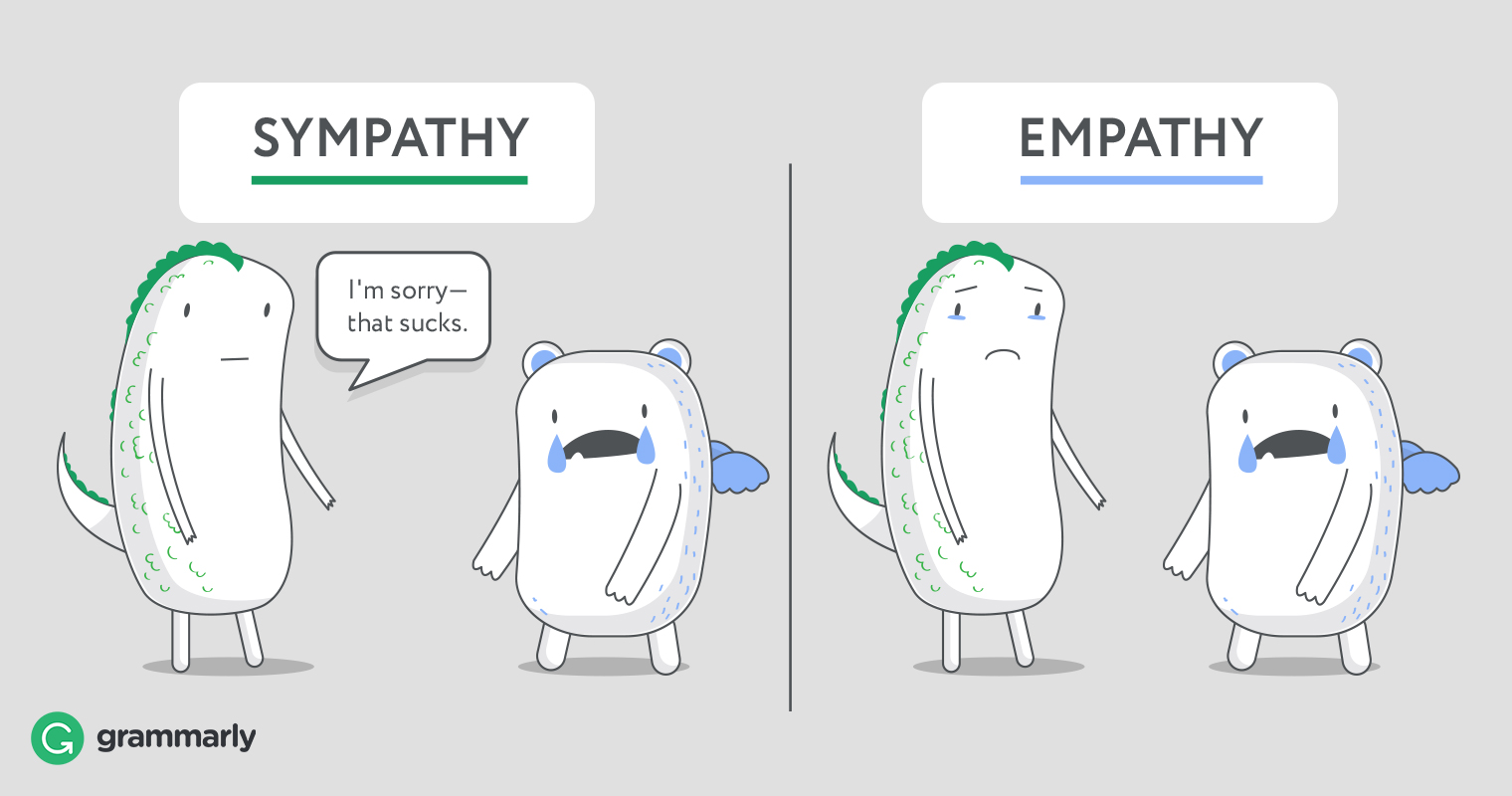
As someone who believes deeply in a culture of autonomy, purpose, and mastery, I see the cultural changes taking place, the vision of the #futrureofwork, and the innovation happening as goodness. While the catalysts may not be positive ones, they are catalysts nonetheless. Catalysts are often volatile, and sometimes the reaction created by the introduction of a catalyst is unexpected or unintended, but this is the risk of experimentation and the introduction of a catalyst. Yes, I believe every day we wake up to conduct and participate in experiments, this experiment called life looks like any other experiment, it has constants, variables, and catalysts. These experiments threaten those with legacy mindsets that favor the known, living off the experiments of others, too afraid to experiment themselves and favoring the way things have always been vs. the unknown, the way things will be. In 47 years of life, I can’t recall a catalyst that has so clearly yielded an introvert advantage. While I believe it will be a short-term advantage and introversion will return to a perceived social disadvantage I hope that what we have learned through observation will lead to a long-term positive outcome on the world. I feel for the extroverts who have struggled over the last three months, sympathize, not empathize because I have no idea what they feel. After all, I am an introvert who has been incredibly comfortable in quarantine and, most importantly, I am not them, I am me.
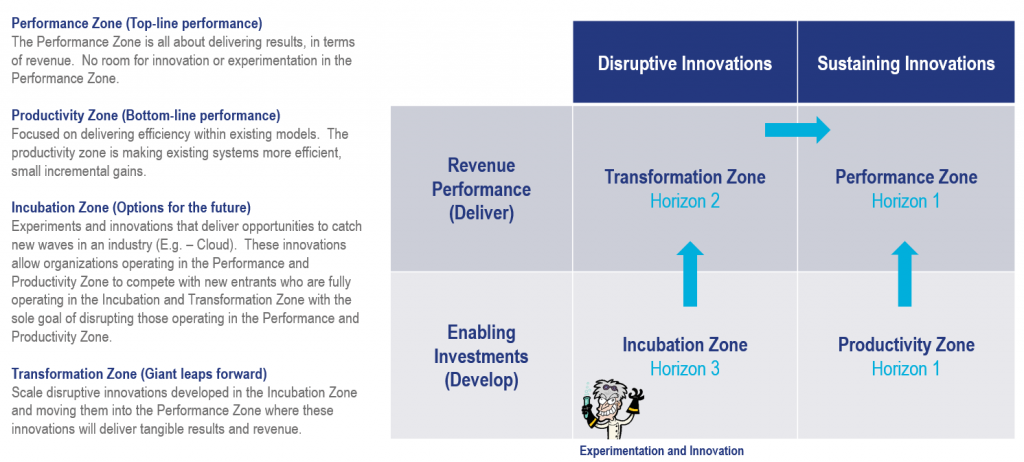
Change is not easy; it can be uncomfortable, scary, and paralyzing, but as someone comfortable with change, I am energized by innovation and disruption. I embrace the risks because I know they unavoidable and I don’t want to be paralyzed by an unwillingness to experiment, but I also follow a scientific method to try to foresee risks and reduce the blast radius. This got me thinking about those I view as risk-averse, and how and when they choose to take risks. Jumping from your second-story window, risking a broken femur when your house is on fire doesn’t make you a risk-taker, it makes you a survivor. Too often we see those comfortable with the status quo want to take risks when it’s too late, when the blast radius can’t be controlled, this is a legacy mindset that favors the status quo over experimentation. Experimentation never ends, it has to be part of the cycle, it’s not easy to disrupt comfortable, but waiting until desperation strikes to act as a motivator is a bad idea with a very big blast radius. In established operating models this can be really hard, this is why I like Geoffrey Moore’s Zone to Win concept. We need a model that allows us to innovate and disrupt in a controlled way, those operating in the Incubation Zone can’t be encumbered by the controls that exist in the performance zone, a move towards tomorrow can’t be restricted by today. The blast radius in the Incubation Zone is smaller and it’s this operating paradigm that should accelerate the velocity of innovation, the frequency of experimentation, and provide the freedom to blow shit up.
I am comfortable alone; I can sit still and concentrate for extended periods; I can persevere in situations that are highly uncomfortable and seemingly never going to change or get better. In a pre-COVID world this was the introvert’s unrecognized and often undervalued advantage, but in a COVID world the relative measures changed, introverts were less or not impacted at all by solitude, while extroverts in some case suffered severe effects. I continue to work on how I approach things to be more palatable to the general public without compromising who I am, my intensity, and the velocity at which I operate. As I get older, I am developing a more profound respect for who I am inherently and a lot more respect and gratitude for the shadow that chases me every day.
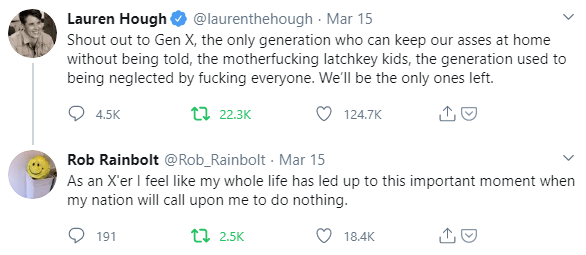
While what we are experiencing right now as a result of COVID-19 is indeed strange, it is indeed an extrovert dilemma, a dilemma faced by me and other introverts our entire lives. This dilemma can be overcome through the discipline to do what is required and not indulge what we desire, I say this not theoretically, but as someone who has worked most of their life to do just this.
To maintain a team connection, our team has been holding virtual events multiple times per week. We’ve held a virtual two-day kickoff meeting, we’ve done presentations on our mentors, we’ve done murder mysteries, we’ve played the Newlywed Game, and now we are playing the $10,000 Pyramid. We kicked off a book club, and we are reading (hopefully almost done) Malcolm Gladwell’s David and Goliath, which like most of Gladwell’s books offers some solid concepts, a few that stuck with me were:
- Success requires risk-taking, a willingness to upset others, and the mental strength to stay the course.
- Privilege and advantage are not correlative.
- Trauma and courage and resilience are correlative. The struggle to battle adverse conditions and survive teaches us more than we know.
- Unconventional tactics can change the game.
As an introvert, living in a world that values extroversion, I feel like I’ve had to battle my natural inclination and desire for solitude most days of my life. This battle can be hard to understand by those who don’t live it, in the same way that understanding how the loss of socialization impacts and extrovert can be hard for an introvert to understand. My battles go beyond simple socialization to the distractions of discussions while I am trying to focus, to observing others wasting what I perceive could be productive time, etc. The exhaustion of being an introvert in an extrovert world is neverending. For me, it is further complicated by hypersensitivity to outside stimuli, an inability to control my surroundings, and what often equates to disconnect in motivations and expectations. When it comes to adapting and overcoming, being disciplined has played a significant role for me; in my mind, I simplify things, remove choice, and focus on objectives. As a result, I have built courage, resilience, and become mentally tough.
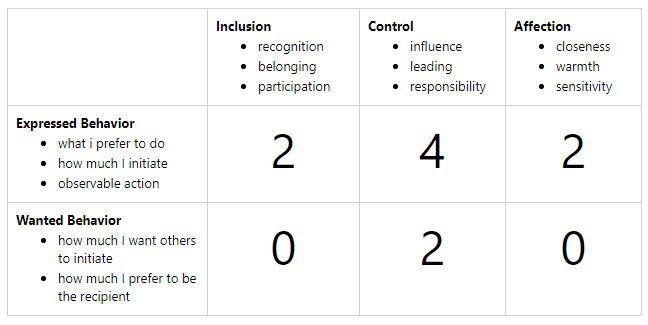
Many years ago I attended a Leadership Training at the Center for Creative Leadership, most people have heard of the Myers-Briggs (MBTI), I am an INTP-A, but I had never heard of a FIRO-B, but as part of the pre-work for the training, I completed a FIRO-B assessment and it was analyzed in a 1:1 session while I was at the training. It was one of the more enlightening exercises for me from a social interaction perspective because it contrasted what I desire and give against what others give and desire. I am not going to provide an interpretation of my FIRO-B below, but the scale is 0-9, with 0 being lowest and 9 being highest. As a result of this exercise, today, I think I am better about disclosing who I am, and I am better at trying to understand what others need and accommodating it. I am still me so I won’t over-rotate here on my ability to accommodate, but my attempts are in earnest.
Three years ago, I sat in a corporate event listening to a motivational speaker talk about positive motivators; the entire time, the guy was talking, I thought to myself, does this pollyanna approach to motivation actually work for people? With a follow-up thought, what happens when it doesn’t work? What happens when you fill your brain with nothing but positive thoughts, and everything that happens is bad? So bad the horizon is not visible, where you have no idea if or when things will improve? Can you survive? Can you go on? When the speaker called for questions, I raised my had and asked: “What do you do if you feel like someone is chasing you all the time? You can’t see them, but they are chasing you every minute of every day?” This guy was at a loss for a response, other than to give me a look that said, seek professional help.
This past weekend I watched “Joe Rogan Experience #1492 – Jocko Willink.” I called my wife over at the snippet below as I gleefully grinned, saying, see, there are others out there just like me. (Note: If you are offended by foul language, do not watch.)
To all those not being chased by someone, to all those whose glass is half-full, I sincerely hope the water is always there to refill your glass. The good news is when there is no water, there will be people like me who wake up every day, not wondering if the water will run out, but when. We live our lives every day expecting the unexpected, we enjoy the good and plan for the worst, and we train our brains to conduct measured responses. We are not sad, we are not depressed, we are not confined by our fears we are liberated by them, we are mentally tough and prepared for whatever the experiment called life will thorough at us, we will not ever wallow in despair, we will take action and we will hold ourselves accountable.
In the end, we are all different, we all possess opinions, none of us fully shaped our opinions so in many ways we carry the opinions formed through by context and circumstance of our lives, and none of this is inherently dangerous, it’s human. Where things get dangerous is when we get locked in, when we shut down to new context and circumstance, when we chose to cast a shadow in an effort to hold onto what was rather than shine a light on what should and will be.