Just left a session entitled PAR110 – VMware Infrastructure 3 Operational Readiness: People and Process Considerations. Maybe it is me I was a bit confused during this session, following the morning general session where the advertised VMware ASP (average sale price) was 50K I’m not sure how much of a need there is for ITIL (Information Technology Infrastructure Library) level process and procedures. With an ASP how large can the addressable market be for these services? Will finding opportunities be like searching for a needle in a hay stack? I sensed similar confusion from others in the room. Who is the target audience for this? I am sure it will play very well in the fortune 100.
Yearly Archives: 2006
VMworld 2006 Lab Manager Session
Just completed sitting through PAR105 – ware Lab Manager: Technical Sales Overview which ran from 10 AM – 11 AM.
Interesting session although I was a aware of most of this information from some of the briefings I had from Akimbi prior to the ware acquisition. In no particular order here are some of the notes from the session. Note: I was typing very fast and the slides were changing faster so I do not guarantee that this post is 100% accurate.
- ware announced Lab Manager Public Beta 1 today at VMworld 2006
- Defined market space as Virtual Application Automation
- Competition: Surgient
- Interestingly enough I hit the Surgient web site and on the top of the page there is a quote from EMC π See final note…
- Lab Mgr Avg Deal Size approximately 30K but this quickly grows to 100s of thousands of dollars
- Cost and Licensing Model
- Two Specific Models
- a la carte – 15K per Lab Manager Server + 1K per 2 CPUs
- Enterprise which will include Lab Manager w/ VI Ent or Std plus VMware Workstation
- Two Specific Models
- Performance concerns associated with VMDK snapshots
- Yes, there can be performance degradation but it has not been measured as significant
- Automated IP and SID Management
- Creation of vs
- Checkout from the Lab Mgr library which creates and exact duplicate environment with the same SID but fencing is used to protect the duplicate environment
- Creation of a new config from a template
- Unlike VM templates the creation of a new VM using Lab Manager templates does not copy the base disk but it creates a difference disk so the creation is near instantaneous.
- REDO limitations / best practices
- # of VMDK files per LUN consideration, depends on how you plan to use the system – number of Vicks per LUN is gated by the number of REDO logs per VMDK.
- Target Markets:
- Enterprise/Commercial IT – > Target Mage >10,000 Employees
SIs and VARs -> National and Global
ISVs -> Small, Medium and Large
- Enterprise/Commercial IT – > Target Mage >10,000 Employees
- Target Customers
- CxO – Architecture Committee
- IT Pops
- Application Dev – Management
- Service Opportunities
- 2 Day Jump Start
- Designed to up and running quickly – takes about an hour to get the base system up and going
- Organizations will require assistance with architecture and design, integration, dvt process, best practice, etc…
- 2 Day Jump Start
As a final note, it was interesting to me during the key note this morning that em’s logo was scarce on the partner slide. In particular there was a software partner slide that had Symantec but not EMC on it. I have to wonder if the thought was that EMC is implied or if it was left off intentionally?
VMworld 2006 – Market Segmentation
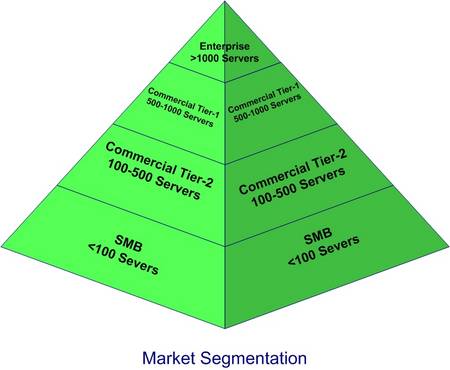
This morning Carl Eschenbach, executive vice president of VMware’s worldwide field operations presented to the VMware partner community and he represented what I feel was one of the better representations of marker segmentation. Many IT vendors are segmenting the marketplace by revenue dollars which proves to be difficult because it does not always directly correlate to IT spend which is what are all most interested in. VMware is representing market segmentation by the number installed servers, which I believe functions as a much better barometer of an organizations investment in technology. I quickly recreated the segmentation model for your viewing pleasure.

VMworld 2006 Interesting Stats
I think I captured most of the relevant stats but I may have missed a few.
Revenue growth:
- 2001 – 8 Million
- 2002 – 22 Million
- 2003 – 76 Million
- 2004 – 218 Million
- 2005 – 387 Million
- 2006 (3 Quarters)- 477 Million
Revenue breakdown:
- 2005 – 82% from partners
- 2006 – 85% from partners
60% of Virtual Infrastructure implementations are on SAN infrastructure
Estimated Terabytes directly driven by virtualization:
- 2004 – 8 TB
- 2005 – 26 TB
- 2006 – 61 TB
- 2007 – 126 TB
Average Deal Size:
- 2004 – 13K
- 2005 – 37K
- 2006 – 50K
- Services drag of 4X
Partners who do VMware and Microsoft services related work will make more money on VMware services than they will on Microsoft related services.
Partners are reporting 23% account base penetration estimated to grow to 45% over the next 2 years.
Market is made up of 38 million x86 servers VMware is installed on 4%.
VMworld 2006 Awards
Technical Achievement Awards
- Americas
- LongView
- EMEA
- Bechtle
- APAC
- Commander
- Global
- INS
- 50 VCPs growing to 65 in the 2 months
Market Maker Awards
- Americas
- Entisys
- EMEA
- ATEA
- APAC
- GT Enterprises
Rising Star Awards
- Americas
- IT Partners
- EMEA
- ITAA (IT Alignment Associates)
- APAC
- NTT Data
Value Added Distributors
- France based AmosDec
“ILM for the SMB”
ILM or Information Lifecycle Management has been in full swing now for about 3 years and I am going to go out on a limb and state that most organizations have not yet implemented an “ILM” strategy. I believe the reason this is the case is because “ILM” is in fact a vision that has been interpreted and evangelized by many vendors as a strategy.
I presented a session at Storage Networking World in Orlando last week entitled “ILM for the SMB”. This is a scary proposition, most enterprise class organizations have leveraged “ILM” to implement tiered storage strategies and transparent data movement through the use of software to migrate data based on simple taxonomy like last access date, file type, owner, etch… Is there any value in an “ILM” strategy for the the average SMB (Small and Medium Business) who can store their entire data requirements, including overhead for protection on on 3 to 5 disk drives? I think the answer is pretty clear as I stated during the presentation “put all of your data on tier 1 storage and call it a day. you can always add a drive when you run out of space”. Because I was honestly at a loss on how to confidently articulate the value of “ILM” for the SMB I offered up a new definition for the SMB where the “I” in “ILM” changes from “Information” to “Infrastructure”. Many SMBs suffer from what I call the eBusiness syndrome, an epidemic feed by the likes of CDW and Dell . These users buy technology from distributors who offer little or no coaching on the applicability of the technologies or how to extract value from the technology, thus many SMBs find themselves replacing technology or purchasing point solutions and building infrastructures held together for scotch tape and chewing gum. A “Total Solutions” approach where the entire infrastructure is addressed is where SMBs will find the most value when amortized over a reasonable period of time. The ability to cost effectively address enterprise class problems on an SMB budget requires coaching and often a partner who can function less as technology salesman and more as an analyst, helping SMB customer avoid disposable technology, extending the lifespan of the infrastructure and add enterprise class functionality where appropriate.
Below I have paraphrased an example that I gave during my SNW session:
How many SMBs are still running Microsoft Exchange 5.5 even though support is EOL? Why? Cost prohibitive to migrate? Customers running Exchange 2000 or 2003 are probably running on 32bit x86 architecture. Microsoft will release Exchange 2007 on 64bit x86 architecture only, what does this mean? It means that the SMB going from 5.5, 2000 and 2003 will be spending significant dollars to facilitate a painful upgrade process to 2007, potentially investing in new hardware, new OS licensing, new storage capacity, directory services work and finally the Exchange migration work. This is not so bad for the customer who has been running Exchange 5.5 on a Pentium II and NT 4.0 for 8 years (they have gotten their monies worth) but how about the guy who bought a new 32bit server from CDW 2 months ago because Exchange 2000 was running slow, well bad news, support for Exchange 2000 will be EOL and Exchange 2007 requires 64bit architecture. That is the definition of disposable technology.
Reality is that the SMB needs help with “Infrastructure Lifecycle Management”. The ability to predict and extend a solutions life cycle while balancing budget with quality and functionality adds tangible value today, this is not a vision but a strategy which can be applied in a tactical manner.
While today there are few compelling reasons for the SMB to determine how to apply the “ILM” vision to their corporate information infrastructure that may be changing. See my follow-up post entitled “ILM and eRisk”.
VMworld 2006 – Partner Day
6AM on the west coast and we’re off to a rocky start here at VMworld. I have to catch a shuttle bus to the convention center? Walking distance people… no one likes shuttle buses, there are enough venues with convention facilities within walking distance I’ll never get the shuttle bus thing.
The eve of VMworld 2006
On the eve of VMware 2006 I though I should post a blog. Nothing much to say other than I expect this to be an active blog week. I will be logging directly from VMworld hopefully in real time. Couple of thoughts to start the week off.
First I need to vent about the schedule builder schedule builder – I feel like I am eighteen again registering for college classes. Typically as the week progresses at these things I like to solicit feedback from other attendees and it’s nice to be able to morph my schedule and stay away from the sessions that suck, this is kind of hard when I need to be “on the list” – Is this a tech conference or a night club. I think someone needs to take a lesson from their big brother and have a format that closer resembles EMC World (previously the EMC Technology Summit) which in my opinion is probably one of the best run technology conferences going.
Looking forward to a few sessions this week, in particular:
- VMware Community Source Update & Opportunities
- VMware and Hardware Assist Technology (Intel VT and AMD
Pacifica) - SDK Programming
- mark: A Scalable Benchmark for Virtualized Systems
- Virtualization Management APIs: VMware, DMTF and Xen
- VIX Programming
- VMware Lab Manager: Technical Sales Overview
- Little worried about the depth of this session, could be weak.
In case you have not noticed I am really interesting in information related to the extensibility of VI3 because I believe there is significant value in creating elegant solutions by getting outside the box.
See you all there and have a great week.
Gubuntu???
Sitting in my room at SNW (Storage Networking World) and and I thought I would blog about an interesting conversation from last evening about Linux on the desktop mostly because the person I had the conversation with seemed intrigued, so much that we have a follow-up conversation today in the hallway. The discussion was over Gubuntu the rumored Google flavor of the popular Ubuntu Linux Distro. As a huge advocate and user of Ubuntu I can honestly say it is by a large stretch the best desktop Linux distribution to date. I have been using Linux since the early 90s and started on kernel version 0.98 or 0.99, I can’t remember. I do remember downloading the 24 or so floppies @14400 baud that made up the Slackware distribution that I would then install on my 386. The entire process was laborious. Ahhhhh…. But once it was up and running what a feeling of accomplishment. I remember our dorm room network using NE2000 ISA cards and coax cable, I am starting to feel like a geek. The good old days. Since the early days I have tried just about every distribution, early on I flip-flopped between Slackware and Yggdrasil, then I moved onto Debian and even gave Corel Linux (now Xandros, which I have run as well) a shot, next was the likes of Caldera, RedHat, SuSE, Mandrake (now Mandriva). Caldera went away and RedHat/Fedora/CentOS, SuSE and Mandrake all became bloated, the thing I always hated about Microsoft. I then moved onto Gentoo and finally now Ununtu. I have to say the Debian based Ubuntu distribution is incredible. Returning to the topic of the post, Internet banter confirms that Google is working on a distro called Gubuntu, leveraging applications like Google Earth and Picasa which have already been ported to Linux and the Google Desktop which I am sure will be ported to the Gubuntu release and Internet based applications like Google Spreadsheets and Writely (Now Called Google Docs and Spreadsheets) and of course Gmail.
The Linux desktop push has begun, with titans like Google getting into the space and events like Eric Raymond joining the Freespire Leadership Board we may see an insurgence by Linux in the desktop market.
-RJB
Continental seat 21D stream of consciousness…
Sitting on a Continental flight in seat 21D on a flight from Austin, TX to Newark, NJ and I thought I would write a post (maybe this would be better classified as a rant or a stream of consciousness) on change and vision. I realize that this is more of a culmination of random thoughts than anything else but what the heck I’m bored, well not rally bored but need a break from work. Over the past few weeks I have been working relentlessly on powerpoint presentations and writing a lot while I am flying so I thought I would use the last hour or so of this flight to dump a bunch of random thoughts onto paper. Clear some room in my brain for new ideas π
As human beings it is very difficult to step outside our skin and change our perspective. This inability to readily change our perspective in my opinion is the key contributor to our resistance to change and our inability to create a generally acceptable vision. The thought that we may be removed from a comfort zone where we are no longer the authority and forced into the unknown can be frightening. A few years ago (more like 10 years ago) a good friend of mine introduced me to a concept called “Remote Viewing”. “Remote Viewing” is a technique employed and taught by the CIA as a way to visualize things through the eyes of another person (from the CIA’s perspective this would be the enemy). I was blown away and for years I believed that I could learn “Remote Viewing” and it would hold the key to my success in life, the ability to fully commit to someone else’s perspective, to the degree that I would see the situation exactly as they would. I could then take this knowledge and apply it to the mission of morphing their perspective. The ability to do this would provide me the unfair advantage I was looking for. Well needless to say I don’t think anyone has to worry I have not mastered “Remote Viewing” but then again if I had would I tell you π
Interestingly enough as an outgrowth to remote viewing I became interested in something called Neuro-linguistic programming. NLP is a little bit more grounded than Remote Viewing. I researched NLP and purchased and read 4 books on the topic. Once you read the concept you will understand why it was so intriguing to me and for those of you who know me it should be even more evident why I would be so captivated by the concept. My wife can attest to the fact that I am definitely not the life of the party with my philosophical opinions on topics such as “Remote Viewing”, NLP and other bizarre topic like the Bible Code. As a matter of fact years ago she put moratorium on such topics in public settings, thus I am forced to write about them on my blog π
The term “Neuro-linguistic programming” is pretty self explanatory. It is is a set of techniques, axioms and beliefs most often leveraged for personal development. It is is rooted in the study of body language and language patterns. The techniques are predicated upon the principle that all behaviors (whether excellent or dysfunctional) are not random, but have a practically determinable structure. Wow, what an amazing field, the ability to interpret subjective reality. My thought process when I began educating myself on NLP was that I would learn how to morph subjective reality into objective reality.
So I purchased several books on NLP and began to battle through the very dry material in an attempt to learn the techniques and leverage them as a way to get inside my audiences head, understand their subjective reality and create an objective reality aligned with my subjective reality. The ability to lead is firmly rooted in this concept, the creation of a reality that moves people.
What the hell am I talking about, oh yeah…
Why am I writing this? Change is inevitable and our ability to cope and stay grounded is based in our ability to create a subjective reality. The ability to understand and alter the subjective reality of others in my opinion ultimately holds the key to our success. Now the tough part of determining how to do this. My adaptation is a mix that works for me but may not work for others:
- Defined End-State – Having a clear, defensible definition of the end-state is critical.
- Vision – Have a vision. The ability to clearly and concisely convey your vision is key. It’s not over once you achieve the end-state. A vision should not be finite. The end-state should be the horizon, once we reach the horizon a new horizon is created.
- Faith – The only thing that matters is the end-state, while milestones and the measurement of progress are applicable they should not define the map for the journey. Execution of a vision requires a fluid adaptable philosophy executed by individuals with insatiable desire, not individuals with a need to hit milestones. This in my opinion is by far the most difficult aspect of executing against a successful vision. This is not an exact science but rather an art. Often times the painting is meaningless until the last brush stoke is applied to the canvas.
- Commitment – Stay committed and vigilant. The horizon is distant and will often seem like a mirage, the ability to stay focused on the vision and committed to the destination is paramount.
- Flexibility – Be flexible, the ability to influence is predicated on the ability to morph and adapt to detours in the road to the end-state.
Finally for those of you who were boy shouts “Be Prepared”…
Ahhhhh…. I feel refreshed!